A SOC that reasons.
Not a wall of dashboards waiting for a human to read them. Reasoning agents work the queue end to end, escalating to your team only when the call is genuinely contested.
Illustrative split, not a customer metric.
Visibility was never the bottleneck. Action was.
A decade of tools gave the SOC more screens, more alerts, and more dashboards. None of them did the work. The analyst is still the engine, and the engine is overloaded.
Too much to watch
More telemetry than any team can read. Coverage on paper, blind spots in practice.
Humans as glue
People pivot between consoles to assemble context by hand, one alert at a time.
Automation that breaks
The playbooks meant to help crack on every tool change, so trust in automation erodes.
Agents work the queue. Humans set the rules.
In an agentic SOC, the default worker is an agent and the human is the supervisor. Agents investigate, decide, and act within the bounds you set, surfacing the contested calls and high-blast-radius actions for a person. Your team moves from doing every investigation to governing all of them.
- Agents run investigations in parallel, around the clock.
- Humans own the autonomy dial and the contested calls.
- Every action attributable, to an agent or a person, on one trail.
Investigate and triage
Enrich, correlate, score the spread, auto-close the clean.
Contain and remediate
Take reversible action within your thresholds, log everything.
Approve and govern
Decide the contested calls and high-blast-radius moves.
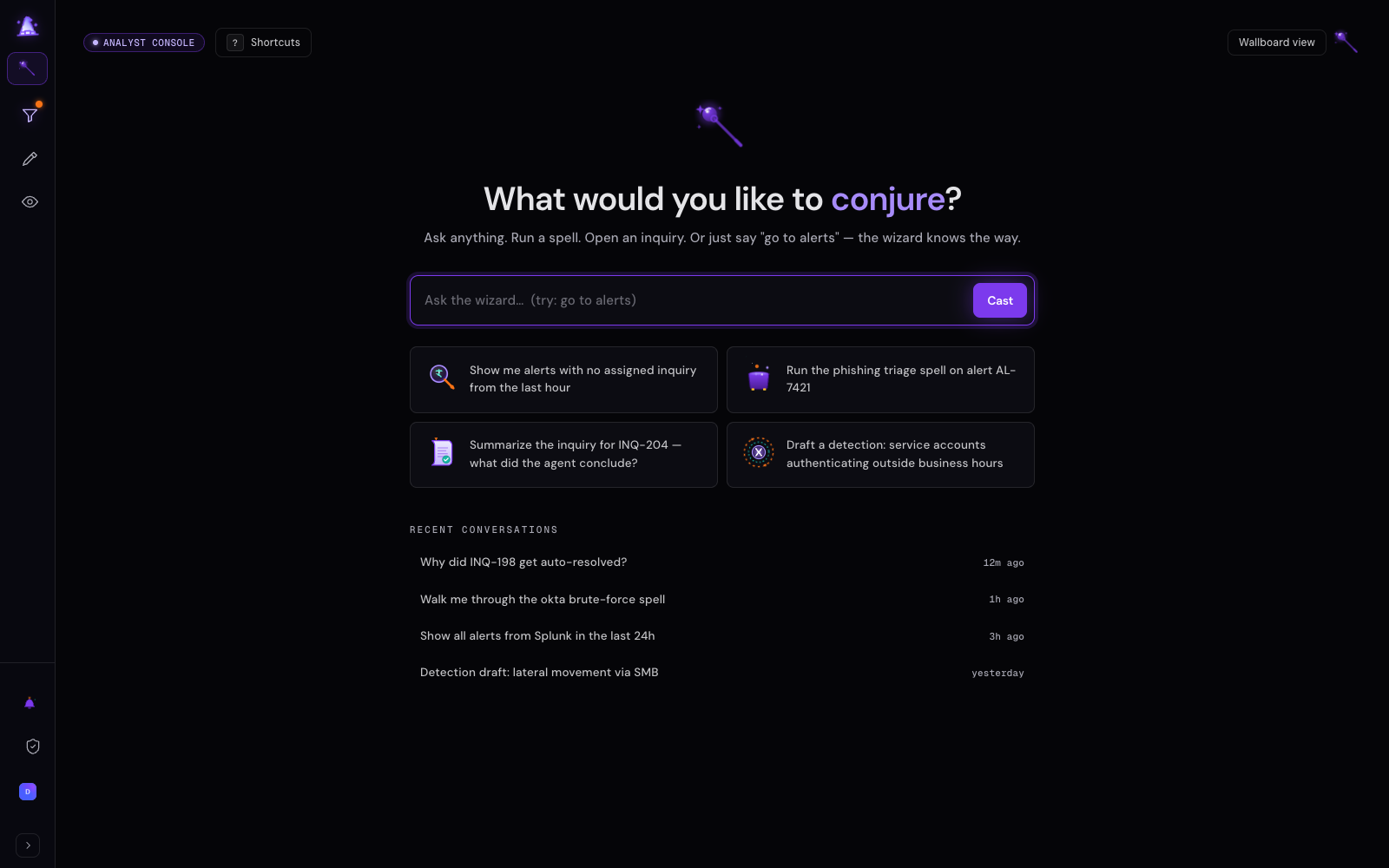
Actual product. Demo data.
The console your agents report to
This is the working surface of the agentic SOC: ask in plain English, pick up a suggested investigation, or review what the agents already ran. Every thread above is an investigation an agent carried, with the evidence attached.
Start with one tier. Grow the autonomy.
See agents work your real queue in a 30-minute walkthrough.